B
B-cell acute lymphoblastic leukemia
IGH and, where appropriate, light-chain rearrangements can provide patient-specific markers for treatment-response and follow-up monitoring.

Seq-MRD is designed for diseases in which a malignant B- or T-cell clone carries a trackable immune receptor rearrangement.
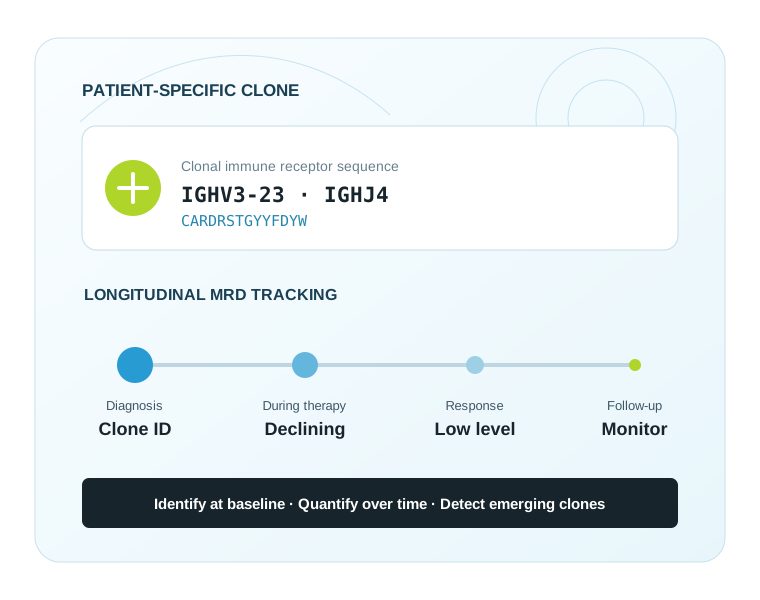
IGH and, where appropriate, light-chain rearrangements can provide patient-specific markers for treatment-response and follow-up monitoring.
TRB and TRG rearrangements can be evaluated as molecular tracking targets in T-lineage disease.
Clonal immunoglobulin rearrangements may support molecular monitoring in selected clinical or research settings.
Baseline identification and high-depth follow-up can support assessment of residual clonal plasma-cell disease when a suitable marker is found.
Selected lymphoma subtypes may be evaluated using disease-associated Ig or TCR rearrangements, depending on sample type and clonality.
Longitudinal molecular endpoints can support translational studies, CAR-T monitoring programs and drug-development workflows.
A baseline sample with adequate disease burden is essential for marker discovery. Follow-up specimen selection should reflect disease biology, treatment protocol and the laboratory’s validated procedures.
| Testing stage | Typical purpose | Possible specimens | Key consideration |
|---|---|---|---|
| Baseline clonality | Find dominant disease-associated BCR/TCR markers | Bone marrow, blood, tissue, extracted DNA | Use a specimen with sufficient malignant-cell burden |
| On-treatment MRD | Measure depth and kinetics of response | Bone marrow or blood, depending on disease/protocol | Collect at protocol-defined time points |
| Post-treatment follow-up | Track known markers and screen for emerging clones | Bone marrow, blood or other validated specimen | Interpret trends with clinical and laboratory context |
| Clinical trial | Generate standardized molecular endpoints | Protocol-specified serial specimens | Predefine sampling, input, thresholds and data handling |
To discuss a project, provide the disease, intended use, sample types, expected number of patients and time points, geographic market and any protocol-specific sensitivity or reporting requirements.
Start a discussionClinical testing, translational research, clinical trials and biopharma collaborations.