VJ
Primer-bias control
Synthetic V–J-like controls can be used to optimize multiplex primer balance and improve library consistency.

Seq-MRD®—developed by ImmuQuad Biotech—uses next-generation sequencing of B-cell and T-cell receptor gene rearrangements to identify disease-associated clones and track them across treatment and follow-up.
Designed for professional use in lymphoid hematologic malignancies. Assay configuration depends on disease, sample type and intended use.
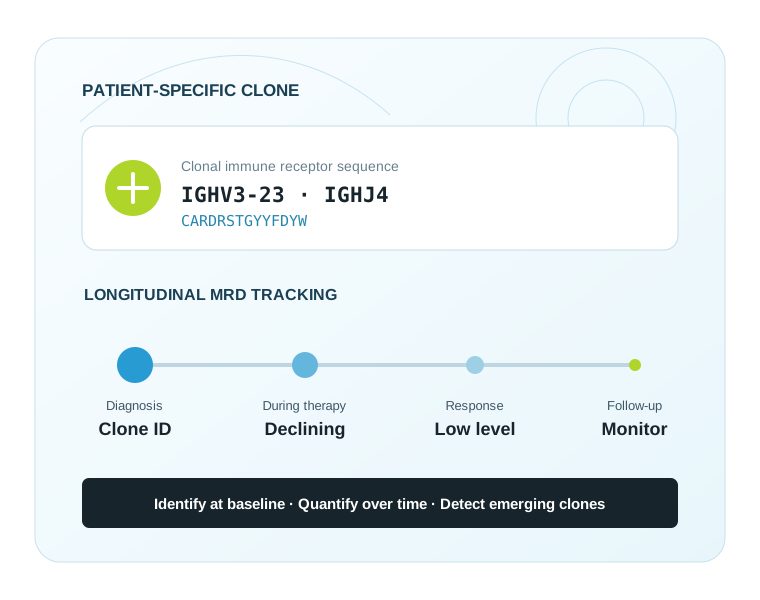
After treatment, a small number of disease-associated cells may remain below the detection range of routine morphology. Sensitive MRD monitoring can help clinicians assess response, refine risk evaluation and watch for molecular evidence of recurrence.
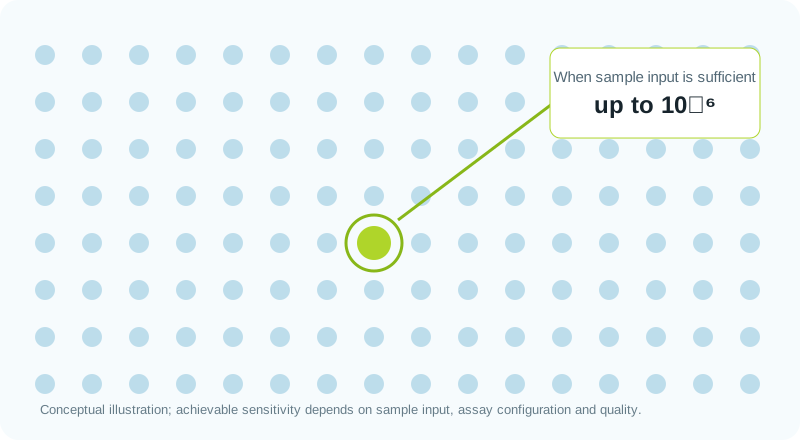
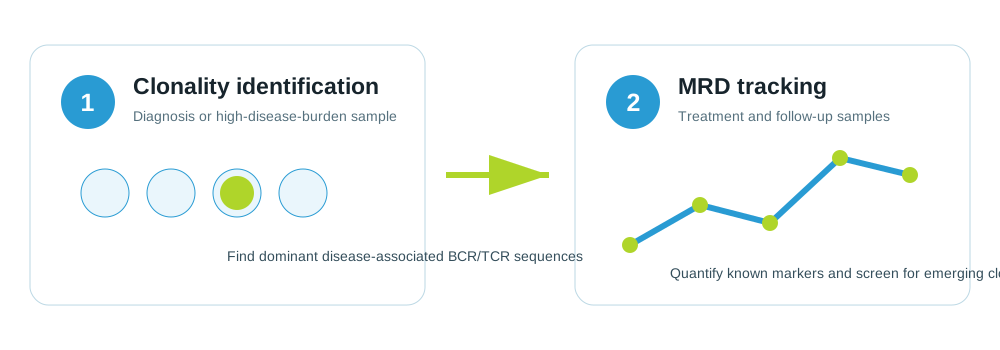
Seq-MRD begins with a high-disease-burden sample to identify disease-associated immune receptor sequences, then uses those sequences as molecular markers during therapy and follow-up.
Synthetic V–J-like controls can be used to optimize multiplex primer balance and improve library consistency.
Internal reference materials support estimation of total nucleated-cell equivalents rather than reporting clone frequency alone.
Multiple BCR and TCR loci can be evaluated to improve the opportunity to find trackable disease-associated rearrangements.
The assay strategy is designed to reduce loss of detection caused by somatic hypermutation in relevant B-cell malignancies.
ImmuQuad’s reference repertoire database and Uniqueness Index contribute to interpretation of significant clones.
Follow-up analysis can assess known markers while also screening for newly emerging clonal sequences.
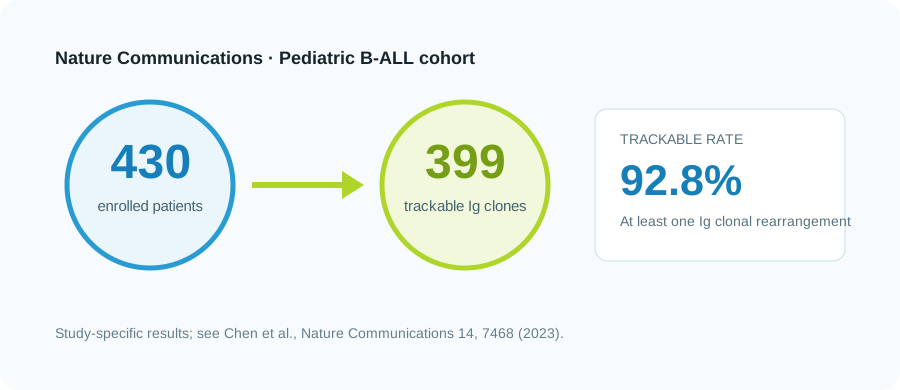
A 2023 Nature Communications study enrolled 430 pediatric B-ALL patients. At least one trackable immunoglobulin clonal rearrangement was identified in 399 patients (92.8%). The study evaluated IGH, IGK and IGL rearrangement-based MRD at the end of induction and consolidation.
A separate 2022 Bone Marrow Transplantation study evaluated NGS-MRD after CAR-T therapy in 20 patients with relapsed/refractory B-ALL who achieved complete remission.
Explore the evidenceB-ALL and CLL/SLL applications may use immunoglobulin rearrangements as patient-specific molecular markers.
T-ALL and other T-lineage malignancies may be assessed through TCR rearrangement targets.
Selected B- or T-cell lymphomas and multiple myeloma may be suitable depending on sample quality and marker availability.
Clinical testing, translational research, clinical trials and biopharma collaborations.