1
Clonality identification
A diagnostic or relapse specimen with high disease burden is sequenced to identify dominant disease-associated immune receptor rearrangements—the patient’s molecular tracking markers.

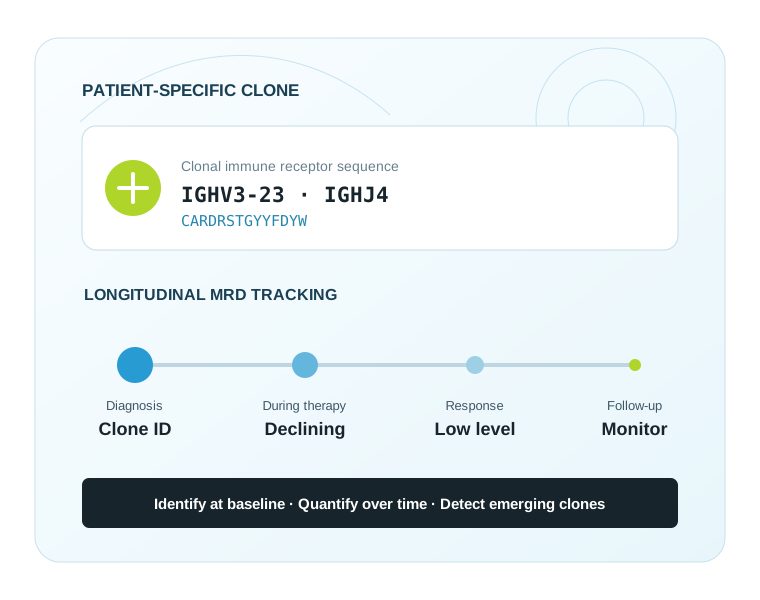
Patient-specific BCR/TCR rearrangements provide molecular labels that can be identified at high disease burden and followed throughout treatment.
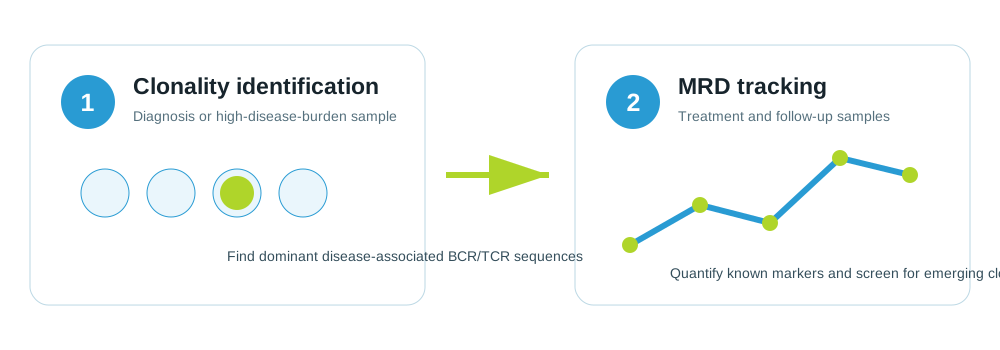
A diagnostic or relapse specimen with high disease burden is sequenced to identify dominant disease-associated immune receptor rearrangements—the patient’s molecular tracking markers.
One or more follow-up specimens are tested for the previously identified markers. Analysis also screens for new clonal sequences that may reflect clonal evolution or a new process requiring review.
V(D)J recombination and junctional nucleotide addition/deletion create highly diverse immune receptor sequences. A lymphoid malignant clone carries a reproducible rearrangement that can be used as a patient-specific tracking target.
Synthetic control molecules that resemble complete V–J rearrangements support primer balancing and help reduce multiplex-PCR amplification bias.
An internal reference library supports estimation of the total nucleated-cell equivalent used as the MRD denominator.
TRB, TRG, IGH, incomplete IGH, IGK and IGL are included in the platform’s broader receptor assessment strategy.
Assay design addresses somatic hypermutation, which can otherwise reduce detection of B-cell receptor targets.
ImmuQuad’s large TCR/BCR reference database and a Uniqueness Index contribute to assessment of significant clonal sequences.
With sufficient sample input, sequencing depth can support detection approaching one target receptor sequence per million receptor templates.
| Report component | Purpose |
|---|---|
| Baseline clonotype profile | Documents disease-associated sequence markers identified in the high-burden sample. |
| Marker-specific quantitative result | Reports the detected level of each tracked target using the assay’s quantitative denominator. |
| Sample and quality metrics | Provides context on input, sequencing and analysis quality needed for interpretation. |
| Emerging clone observations | Flags newly prominent rearrangements that may require correlation with diagnosis, treatment and other tests. |
| Longitudinal trend | Places the current result alongside previous time points to show kinetics. |
Exact report fields and interpretation language depend on the selected product configuration and local laboratory procedures.
Clinical testing, translational research, clinical trials and biopharma collaborations.